

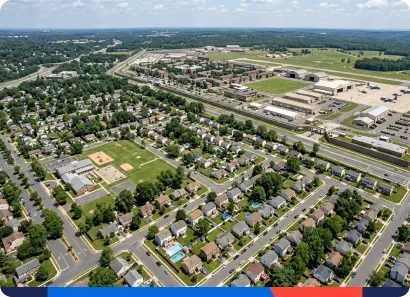
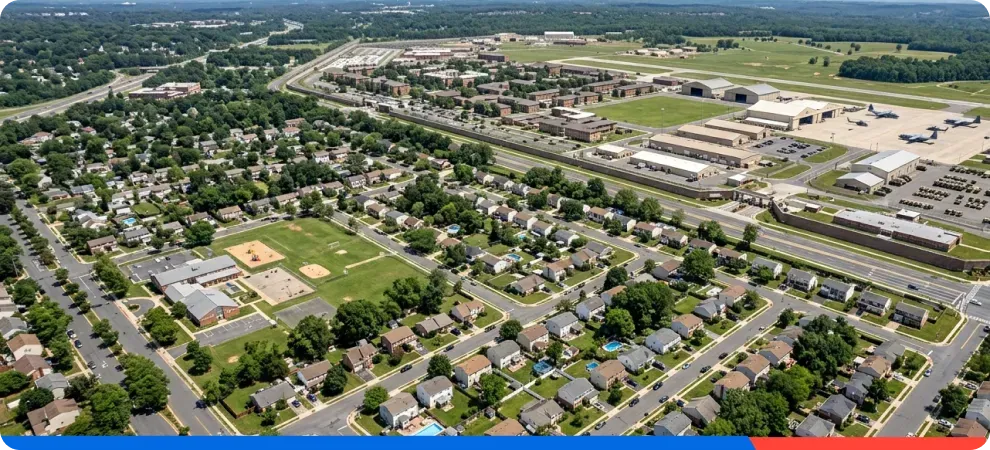

Ask ten Veterans where they settled after service and you will hear different answers from each of them. Some plant roots within a short drive of the nearest installation, while others put real distance between themselves and the gate on purpose.
The decision comes down to what you value most: continued access to base benefits, healthcare, and a built-in community on one side, or quieter surroundings, lower prices, and a fresh start on the other. This guide walks through the reasons behind both choices, and it points you to the resources that can help you decide which fits your next chapter.
The Short Answer
Veterans who buy near a military base usually do it for practical reasons. Retirees keep valuable installation privileges, military and VA healthcare tends to cluster around bases, and the surrounding community understands military life.
Veterans who deliberately buy farther away may be weighing aircraft noise, safety zones, higher home prices near the base, or simply the desire to step fully into civilian life. Both paths are common, and the right one depends on your benefits and your needs.
Why Some Veterans Choose to Live Near a Base
For many who have served, proximity is about access to benefits that don’t disappear when the uniform comes off.
Continued access to base benefits
Retirees and many other Veterans keep their installation privileges for life, and those privileges are easier to use when you live nearby. With a valid uniformed services ID, eligible Veterans can shop tax-free at the commissary and exchange, use Morale, Welfare and Recreation facilities. The commissary sometimes prices groceries and household goods below nearby civilian stores, so those savings add up over a year for anyone who shops there regularly.
Living twenty minutes from the gate makes these perks part of everyday routine rather than an occasional trip, and that convenience is a real draw for retirees on a fixed income.
Proximity to military and VA healthcare
Healthcare is one of the biggest reasons Veterans stay close. Military retirees enrolled in TRICARE Prime often receive care through a Military Treatment Facility, and those facilities sit on or beside installations. On top of that, VA hospitals and clinics are frequently concentrated in and around military communities. Before you commit to any neighborhood, it is worth mapping exactly what care sits within a reasonable drive using the VA facility locator, especially if you manage a service-connected condition that requires regular appointments.
A community that gets it
There is also the human side of the equation. Base-adjacent towns tend to have a high concentration of Veterans and active-duty families, so neighbors understand deployments, transitions, and the rhythms of service in a way civilian communities sometimes do not. For Veterans who miss that shared language, a military town can feel like home in a way a random suburb never would.
Resale and rental potential
Finally, there is a financial argument. Homes in strong military markets usually enjoy steady demand from a rotating pool of buyers and renters, since new families arrive with every assignment cycle. A well-kept home with broad appeal can therefore be easier to sell later, and it may hold value as a rental if you move on. That built-in demand is a genuine advantage, though it works best for practical, resellable homes rather than highly customized ones.
Why Others Deliberately Buy Farther Away
For every Veteran who wants to stay close, another chooses distance on purpose, and their reasons are just as sound.
Noise
Living next to an airfield sounds convenient until jets are running at dawn. The Department of Defense studies and maps this through the Air Installations Compatible Use Zones program, which identifies noise contours and accident potential zones around military airfields and recommends compatible land uses for the surrounding area. According to DoD Instruction 4165.57, some land immediately off the runway carries enough accident risk that residential development is discouraged or restricted outright. Veterans who value peace and quiet may study these maps and choose to live well outside the loudest zones.
Price premiums near the gate
Convenience comes at a cost. Homes within a quick commute of a busy installation frequently command higher prices and sell faster because demand is concentrated there. A Veteran willing to drive an extra fifteen or twenty minutes can sometimes get a larger home, a better lot, or a stronger school district for the same money. So for budget-focused buyers, the gate premium is a reason to consider looking outward.
A clean break from military life
Not every reason is financial. Plenty of Veterans spend years surrounded by the routines of service, and when they separate, they want something genuinely different. Choosing a town with no visible connection to the military can be part of closing one chapter and starting another. That desire for a fresh identity is valid, and it is one of the most personal factors in the whole decision.
Schools, space, and lifestyle fit
Families often prioritize the things that shape daily life over proximity to work. A quieter neighborhood, more land, a specific school, or a particular climate can easily outweigh a short commute. Because the home you buy after service may be the one you keep for decades, many Veterans decide that lifestyle fit matters more than being close to the gate.
How Your Home Loan Benefit Fits Either Choice
Your VA home loan benefit works the same whether you buy across from the base or three states away. The benefit is nationwide, so location does not change your eligibility. What the program does require is that the home be your primary residence, not a vacation property or a pure investment, and you can review those basics on the official VA home loans page. That flexibility means the geography question is entirely yours to answer, and your earned benefit follows you wherever you decide to settle.
How to Decide for Your Own Situation
These steps may help clarify the choice.
- List the benefits you'd use. If you shop the commissary weekly or rely on a Military Treatment Facility, proximity has real value. If you rarely use base services, it matters far less.
- Map your healthcare first. Search the VA facility locator for the clinics and hospitals you will depend on, then measure the drive from any neighborhood you are considering.
- Check the noise and zoning picture. Look into the installation's compatible use zones and, if you can, visit prospective streets at different times of day to hear what mornings and evenings sound like.
- Run the full cost. Compare home prices near the gate against options farther out, and factor in taxes, insurance, and commuting costs before you decide the premium is worth it.
Consider the life you want. Ask yourself whether you want to stay connected to the military community or step into something new, because that answer may settle the whole question.
Deciding where to live after service is one of the most personal choices you will make, and there is no single right answer for everyone who has worn the uniform. Read more about Veteran lifestyle topics to keep weighing your options and planning your next move with clarity.
FAQs
Is it a good idea for Veterans to buy a house near a military base?
It can be, depending on how you live. Proximity pays off if you regularly use base benefits like the commissary, exchange, or a Military Treatment Facility, and if you value a community that understands service. It makes less sense if noise, higher prices near the gate, or a desire for a quieter civilian setting weigh more heavily for you.
Do Veterans keep base access after leaving the military?
Many do. Retirees and certain other eligible Veterans keep installation privileges with a valid uniformed services ID.
Why do some homes near military bases cost more?
Higher demand. Base-adjacent neighborhoods draw a steady stream of arriving families every assignment cycle, and that concentrated demand tends to push prices up and speed up sales.
What is the downside of living too close to a military airfield?
The main downsides are noise and safety zoning. The Department of Defense maps noise contours and accident potential zones around airfields, and it discourages or restricts residential use in the highest-risk areas. Even outside those zones, aircraft operations and training activity can affect daily life, so it pays to research flight patterns before buying.
Does my VA loan require me to live near where I served?
No. The VA loan benefit is nationwide and does not tie you to any region. Where you use the benefit is completely up to you.