



I got out of the Marine Corps in January 2024 after eight and a half years, part of it with a Light Armored Reconnaissance unit. I still wake up at 6 a.m. and train for two hours. Nobody has to copy that. The routine isn't the thing that carried over from the service. The structure underneath it is, and that part scales to anybody.
In uniform, three things kept you fit whether you wanted to be or not. Somebody else owned your calendar. Somebody else wrote the workout. Twice a year a test told you exactly where you stood.Separation takes all three at once, which is why so many of us fall off in the first year out. Rebuild those three pieces yourself: a standard you test against on a fixed date, a reason that holds up on the mornings you don't feel like it, and people who notice when you don't show up.
Guideline 1: Swap the Schedule For a Goal
I still take both Marine Corps fitness tests, the Physical Fitness Test (PFT) and the Combat Fitness Test (CFT), twice a year. I still score 1st Class on both for my current age group. Nobody makes me do it. I do it so that if they ever needed me to come back in, I could still show up those young kids.
A workout plan asks how you feel this morning, and some mornings the honest answer is bad. A test asks what you can do, then asks again in six months and has no interest in what got in the way. Skip a week of training, nothing happens, but if slacking becomes habitual, it’ll show up on the test.
Pick a Goal You Can Retest
Write down today's number and put the retest on your calendar. Pick something that fits the body you have now:
- A set distance you cover on foot, on a bike, in a chair, or in a pool, timed.
- Max push-ups and pullups in two minutes, or max reps of whichever push variation your shoulders will tolerate.
- How many times you can stand up out of an armless chair in 30 seconds.
For the floor underneath all of it, the Physical Activity Guidelines for Americans say adults need 150 to 300 minutes of moderate-intensity activity a week plus muscle-strengthening work on at least two days. The CDC points out you can break the aerobic half into 30 minutes across five days. That's a lunch break.
Guideline 2: Find Your Why, Give it 100%, Then Go 20% Harder
My why came out of a 20 kilometer hike at infantry school. Pack, weapon, full gear, I weighed close to 350 pounds all in, hours into the sun, and I remember thinking, why am I doing this? I didn't have to do this. I want to go home. Then one of our instructors said something I've never forgotten: “Guys, remember your why.”
My why is my family. Being able to give them a life they never had access to before is worth getting up for.
The second thing I took off that hike is the part I use on ordinary Tuesdays. When you think you're going 100%, but you actually have another 20% in you.
I found out how true that was in the water. I nearly drowned twice as a kid, at four years old and again in third grade, so I went into boot camp afraid of the swim qualification every Marine has to pass, but when the time came to take the test and I saw that there were other guys who were afraid too, my fear evaporated. Then came Reconnaissance training, where the swimming gets a lot worse with underwater work, a cold ocean, and longer distance. I told myself there was another 10 or 20 percent in me and I just needed to get my mind straight.
Day to day, that extra twenty percent shows up in unremarkable places. I take stairs two at a time. I time my own grocery runs. I try to get every bag in from the car in one trip. None of that is training, and all of it keeps me honest between sessions. Any amount of movement counts for something, so I go looking for it.
Guideline 3: Stop Training Alone
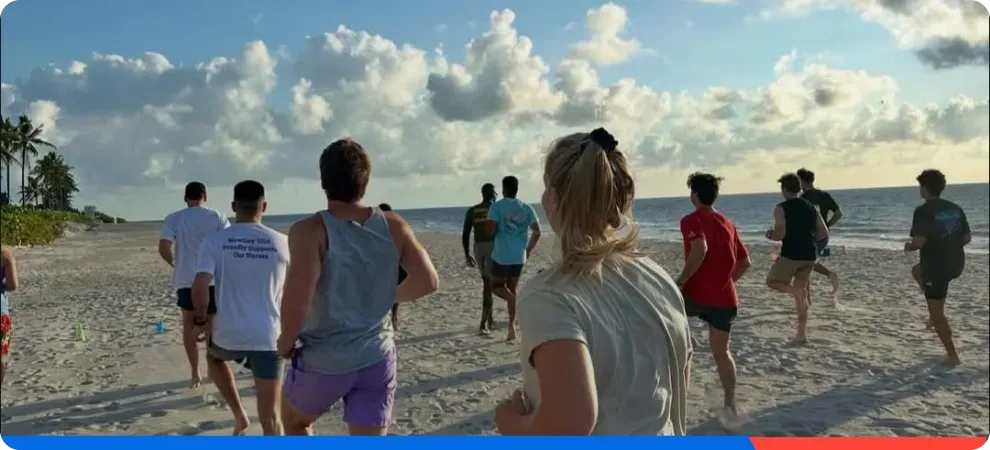
I've deliberately put myself around peers who train, and the effect is close to still being in a unit. Every month I take a group of brand new colleagues out to a beach in West Palm Beach and run them through the kind of workout we did in the service. Sand everywhere, most of them a few days into a new job, doing something they never thought they’d be doing that week.
Afterward we talk about it, and mostly we talk about team cohesion. I'm always happy for everybody who shows up. Even if you didn't do a single rep, you showed up, and that's exactly what you're going to do for the Veteran family on the other end of the phone.
If you don't have a group, the VA has some options:
- MOVE!, VA's national weight management program, pairs nutrition and behavior support with physical activity, and the clinician-led group sessions have the strongest results of the formats it offers.
- Many VA medical centers run in-person and virtual movement classes through Whole Health's Moving the Body resources. Your facility can tell you what's on the local schedule.
When the old standard doesn't apply anymore
I'm not going to pretend my routine is the model. I got out at an age and in a condition that let me keep training like I never left. Plenty of Veterans reading this have knees, a spine, lungs, a TBI, or limb loss that already got rated, and a first-class PFT was never the assignment.
Don’t quit. Adults with chronic conditions or disabilities who can't reach the key targets should stay as active as their abilities allow. Movement also helps with some of the conditions a lot of us carry. It can decrease pain from osteoarthritis and reduce symptoms of anxiety and depression.
VA Programs That Meet You Where You Are
VA Adaptive Sports and Arts
VA's National Veterans Sports Programs office runs national rehabilitation events and funds community programs in all 50 states through its Adaptive Sports Grant Program. Cycling, sailing, archery, skiing, wheelchair softball, equine programs. These programs are coached, modified, and built for Veterans with disabilities.
National Veterans Golden Age Games
Open to enrolled Veterans 55 and older, the Golden Age Games run competitions in swimming, cycling, power walking, shuffleboard, cornhole, and more. The motto is Fitness for Life. Participation is the whole idea.
Changing the test doesn't change the method. My benchmark is a first-class PFT. Yours might be six chair stands turning into nine by March. The same mechanism and the same brutal personal honesty applies.
What the Training Is For
I found out how important my workouts were when they got taken away. I was living in Washington D.C. in 2020 when everything shut down during COVID, gyms included. After about two and a half weeks, I was struggling mentally and hadn't connected it to the training I wasn't doing. I'm not a runner, but I went outside and ran anyway, and it really helped me get through that period of time. That's when I understood just how important moving my body is to me.
Research backs that up. A review led by a VA clinical psychologist found preliminary evidence that exercise reduces PTSD symptom severity in Veterans. The authors noted that larger trials were needed, and nobody is calling it a substitute for treatment.
I often think of a line every service member has heard: get comfortable being uncomfortable. Speaking in front of a room, a hard conversation, meeting your girlfriend's father. Life consists of a lot of uncomfortable situations.
If any of this hit a nerve, make the next step small. Pick one goal that’s about 20% better than where you are now, write it down, and set the retest date before you close this page.
Read more about Veteran lifestyle topics.
FAQs
How much exercise does a Veteran need each week?
The same as any adult: 150 to 300 minutes of moderate-intensity aerobic activity, plus muscle-strengthening work on two or more days. Starting from zero, start smaller and build. Some movement beats none, and there's no minimum session length you have to hit for it to count.
Does VA offer fitness or weight management programs?
Yes. MOVE! is VA's national weight management program and includes physical activity coaching alongside nutrition and behavior change support. Many VA facilities also run Whole Health movement classes, and VA funds adaptive sports programs nationwide.
What if my service-connected disability limits what I can do?
Then the plan changes but the value of setting a goal doesn't. Work with your VA care team on what's safe, ask your facility about adaptive sports, and set a benchmark that matches the body you have. Staying active according to your abilities is the recommendation for adults with chronic conditions or disabilities.
How do I stay motivated without a unit or a first sergeant?
Rebuild the two things the unit gave you. Put a retest on the calendar so missing weeks has a consequence, and train somewhere people expect you. A gym partner, a VA class, a walking group, a rec league.