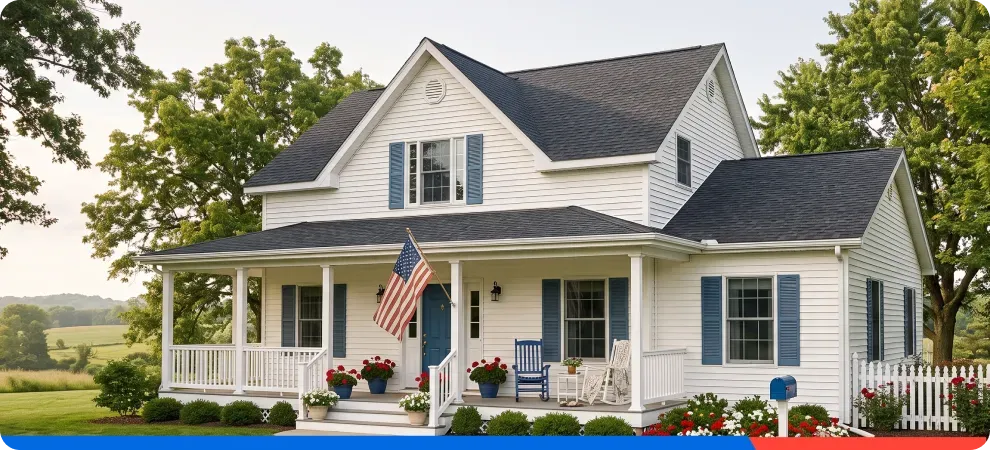

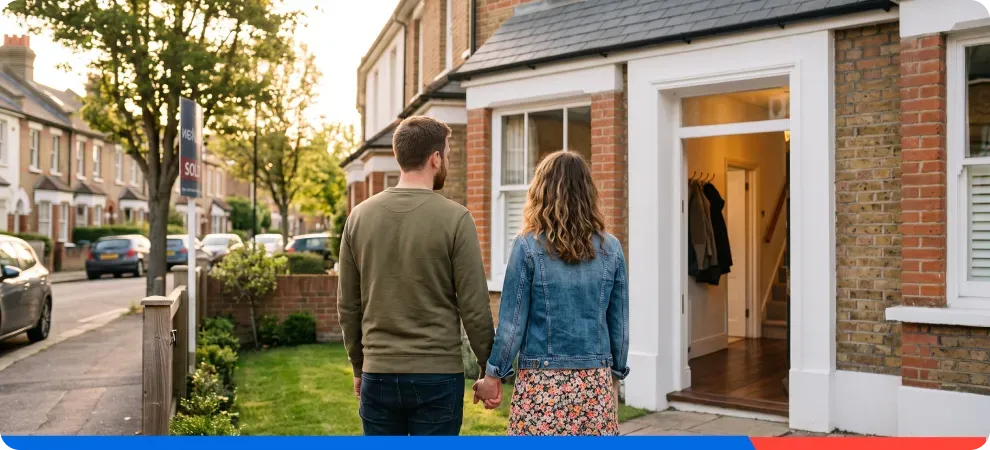

Buying your first home is a milestone, and for Veterans and service members the VA loan benefit makes it far more reachable than most first-time buyers realize. The path is straightforward:
- Confirm your eligibility and get your Certificate of Eligibility
- Get preapproved with a VA lender
- Find a home that meets VA standards
- Make an offer and close
This can often be done with no down payment and no monthly mortgage insurance. Knowing the steps is what turns a big goal into a manageable process.
Why the VA Loan Stands Out for First-Time Buyers
The benefit was built for exactly this moment. According to the Department of Veterans Affairs, a VA-backed purchase loan lets you buy a home with no down payment as long as the sales price does not exceed the appraised value, and it comes with no private mortgage insurance and competitive interest rates. For a first-time buyer, skipping both a large down payment and monthly insurance is a substantial head start.
The VA does not lend the money directly. It guarantees part of a loan made by a private lender, which is what allows those favorable terms. Your job is to meet the eligibility and credit requirements and find a home that qualifies.
Step 1: Confirm Your Eligibility and Get Your COE
Everything begins with the Certificate of Eligibility, or COE, which proves to a lender that you qualify based on your service. Per the Department of Veterans Affairs, eligibility generally requires a minimum period of active-duty service, typically at least 90 continuous days during wartime or 181 days during peacetime, or six creditable years in the National Guard or Selected Reserve, with different rules by era of service. Surviving spouses may qualify in certain situations as well.
You can request your COE online through the VA, ask your lender to pull it for you, which is often the fastest route, or apply by mail. Beyond the COE, you will need satisfactory credit and enough income to cover the loan, and the home must be one you intend to live in as your primary residence.
Step 2: Understand Entitlement and Loan Limits
Entitlement is the amount the VA will guarantee on your behalf, and it shapes how much you can borrow with no money down. Most first-time buyers have full entitlement, and with full entitlement there is no cap on how much you can borrow without a down payment. Your lender's assessment of your income and credit becomes the practical ceiling, not a VA limit.
Loan limits only come into play if you have reduced or partial entitlement, for example if you have an active VA loan or a prior one that has not been restored. In that case, the VA ties your no-down-payment amount to the conforming loan limit. For 2026, the Federal Housing Finance Agency set the baseline limit for a one-unit home at $832,750, up $26,250 from 2025, with a ceiling of $1,249,125 in high-cost areas. If you have full entitlement, this number does not restrict you.
Step 3: Get Preapproved and Compare Lenders
Preapproval tells you what you can afford and signals to sellers that you are serious. It also gives you time to compare offers, which can save real money.
Rates and fees vary from lender to lender, so gather more than one quote. The Consumer Financial Protection Bureau recommends comparing the Loan Estimate from each lender, a standardized form that lays out the interest rate, monthly payment, and total closing costs side by side. Because every Loan Estimate follows the same format, you can line them up and see the real differences quickly. Do not hesitate to ask lenders to compete for your business.
Step 4: Budget for the Funding Fee and Closing Costs
Most VA buyers pay a one-time VA funding fee, which helps sustain the program for the next generation. Per the Department of Veterans Affairs, the fee for a first-time purchase with no down payment is 2.15% of the loan amount, and it can be rolled into the loan rather than paid in cash at closing.
Many buyers owe nothing at all. Veterans who receive VA disability compensation, certain surviving spouses, and active-duty Purple Heart recipients are exempt, and the VA reports that since 2021 more than half of Veterans who obtained a VA-guaranteed loan paid no funding fee. You will also have standard closing costs such as the appraisal, title work, and recording fees, though a seller can agree to cover some of these. Ask your lender for an early estimate so there are no surprises.
Step 5: Find a Home That Meets VA Standards
Not every property qualifies, so this step matters. Any home bought with a VA loan must meet the VA's Minimum Property Requirements, meaning it has to be safe, structurally sound, and sanitary. A VA appraiser confirms those standards and establishes the home's value during the appraisal.
Because the appraisal is an eligibility and value check rather than a full home inspection, it is smart to order your own independent inspection too. That protects you from problems the appraisal was never designed to catch, and it gives you leverage to negotiate repairs before you commit.
Step 6: Make an Offer, Appraise, and Close
Once you find the right home, your agent helps you write an offer, ideally with an inspection contingency. After acceptance, the VA appraisal is ordered, and the VA issues a Notice of Value confirming the home's worth. Your lender then completes underwriting, verifying your income, credit, and documentation.
If the appraisal comes in at or above your contract price and everything checks out, you move to closing, sign the final paperwork, and get the keys. VA rules generally expect you to occupy the home as your primary residence within a reasonable time after closing, usually about 60 days. From accepted offer to closing, a typical VA purchase runs roughly 30 to 45 days.
Your First Home Is Closer Than You Think
The VA loan benefit rewards Veterans who understand how to use it. Confirm your eligibility, get your COE, compare a few lenders, budget for the funding fee, and focus on homes that meet VA standards. Take the steps in order and lean on professionals who know the program, and a first home with no down payment can move from someday to this year.
Find out more about how to make the most of your VA loan benefit.
FAQs
Do I really need zero down payment?
With full entitlement, yes, you can buy with no down payment as long as the price does not exceed the appraised value. A down payment is optional and can lower your funding fee.
What credit score do I need for a VA loan?
The VA sets no minimum credit score. Individual lenders do, and many look for a score around 620, so it is worth checking your credit early and comparing lenders.
Is there a VA loan limit?
Not if you have full entitlement. If your entitlement is reduced, the no-down-payment amount is tied to the 2026 conforming limit of $832,750 in most areas, higher in high-cost markets.
Do first-time buyers pay the VA funding fee?
Yes, unless you qualify for an exemption. For a first purchase with no down payment, the fee is 2.15% of the loan amount and can be financed into the loan.
Can I use the VA loan benefit again later?
Yes. The benefit is not one-time. Once a prior VA loan is paid off and your entitlement is restored, you can use it again for a future home.