




Every VA refinance has to clear a set of federal requirements before the VA will guarantee it.
The lender must:
- Show a net tangible benefit to the borrower
- Give the borrower a written comparison of the old and new loans
- Wait out a seasoning period on any existing VA loan
- On a rate-and-term refinance of a VA loan, prove that the closing costs recoup within 36 months
Those rules apply to both VA refinance types, the cash-out refinance and the Interest Rate Reduction Refinance Loan (IRRRL), and a lender that cannot show you how a proposed loan meets them is not offering you a VA loan.
Overview of the Two VA Refinances
The VA cash-out refinance replaces any existing mortgage, VA or not, with a new VA-guaranteed loan, and lets you borrow against your equity, change your rate and term, or move a conventional or FHA loan into the VA program. The VA's cash-out page lists paying off debt, funding education, and covering other needs as common uses, and the same loan works with no cash back for a Veteran who only wants to drop mortgage insurance or lower a rate. It requires full underwriting, an appraisal, and a Certificate of Eligibility.
The IRRRL is narrower. It replaces an existing VA loan with a new VA loan at a lower rate or a fixed rate, with no new appraisal or full credit package required by the VA. You cannot take cash out, you cannot use it on a mortgage that is not already VA-guaranteed, and not every VA lender offers it. Most Veterans who refinance end up with the cash-out, either because they want to reach their equity or because their current loan is not a VA loan to begin with, so the sections below use the cash-out as the working example.
What a VA Cash-Out Refinance Can Do
Reach Up to 100% of Your Home's Value
Under 38 CFR § 36.4306, a VA cash-out refinance can run up to 100% of the home's appraised value. Conventional cash-out loans stop at 80%, and FHA at 80% as well, so the VA program gives a Veteran access to equity that other programs leave locked up. Individual lenders set their own cap within that ceiling, so the number to ask for is the lender's maximum loan-to-value, not the VA's.
Carry No Monthly Mortgage Insurance
Conventional refinances above 80% loan-to-value carry private mortgage insurance, and FHA loans carry a monthly premium for most or all of the term. VA loans carry none at any loan-to-value. A one-time funding fee, covered below, stands in for it.
Replace a Non-VA Loan
A Veteran with a conventional or FHA mortgage cannot use an IRRRL, because an IRRRL only refinances a VA loan. The cash-out refinance is the route into the VA program for those borrowers, and it can be structured with no cash back if the goal is only to drop mortgage insurance or lower a rate.
What It Requires
A cash-out refinance is a full underwrite. You will document income, the lender will pull credit and order a VA appraisal, and the property has to be your primary residence. Because the VA guaranty is what makes the no-mortgage-insurance, high-LTV structure possible, the loan can only close with a VA-approved lender, and the lender has to meet the requirements in the next section before the VA will guarantee it.
The Rules Lenders Must Meet on Any VA Refinance
Congress added these protections in 2018 after a period of aggressive refinance marketing to Veterans. They are part of the VA's regulations, and they apply to both refinance types.
The Net Tangible Benefit Test
For a cash-out refinance, the lender must show that you receive at least one of eight defined benefits from the new loan: eliminating monthly mortgage insurance, shortening the term, lowering the interest rate, lowering the monthly payment, increasing your monthly residual income, refinancing an interim construction loan, bringing the loan to 90% or less of the home's value, or converting an adjustable rate to a fixed one.
The Written Comparison, Twice
The lender has to give you a written side-by-side of the old loan and the new one covering payoff amount, loan type, interest rate, term, total of all scheduled payments, and loan-to-value ratio, plus an estimate of the home equity the refinance removes. You receive it within three business days of applying and again at closing, and you sign to confirm you got it both times.
Reading the Comparison Correctly
A payment comparison only tells you something when both sides include the same components. If the current payment on the form includes taxes and insurance and the new payment shows principal and interest only, ask the lender to correct it before you sign anything.
Seasoning
When the loan you are refinancing is itself a VA loan, the new loan cannot close until the later of two dates: 210 days after your first monthly payment on the current loan, and the date you make your sixth payment. A lender that proposes refinancing a VA loan you closed four months ago is not following VA rules.
Rate Floor and 36-Month Recoupment
When a refinance replaces an existing VA loan without adding to the balance beyond payoff and allowable costs, two more tests apply. On a fixed-to-fixed refinance the new rate must sit at least 50 basis points below the old one, and on a fixed-to-adjustable refinance at least 200 basis points below, and discount points alone cannot produce that reduction. The fees and closing costs must also recoup within 36 months through the reduction in your monthly payment. If closing costs come to $4,800 and your payment drops by $100 a month, the recoupment period is 48 months and the refinance does not qualify. You can run that division yourself before you talk to anyone.
Understanding "No Money Out of Pocket"
Many VA refinances are advertised as costing nothing upfront, and that is true in the sense that no cash changes hands at closing. The costs are either added to the new loan balance or offset by an interest rate high enough that the lender covers them.
Neither version is free. One raises what you owe and the other raises what you pay each month, so the useful question for any lender is which of the two applies to your loan and what it adds over the years you expect to hold it.
Watch the Term
A refinance resets the clock, and this is where a lower monthly payment can become a more expensive loan. Refinancing a mortgage you have paid for six years into a new 30-year term lowers the payment while adding years of interest. Shortening the term saves interest but raises the payment, and the VA cautions that unless the rate drops by at least a full percentage point, the higher payment on a shorter term can be more than a household can comfortably carry.
The Funding Fee
Under the VA funding fee schedule, the fee depends on which refinance you use and whether you have used the benefit before.
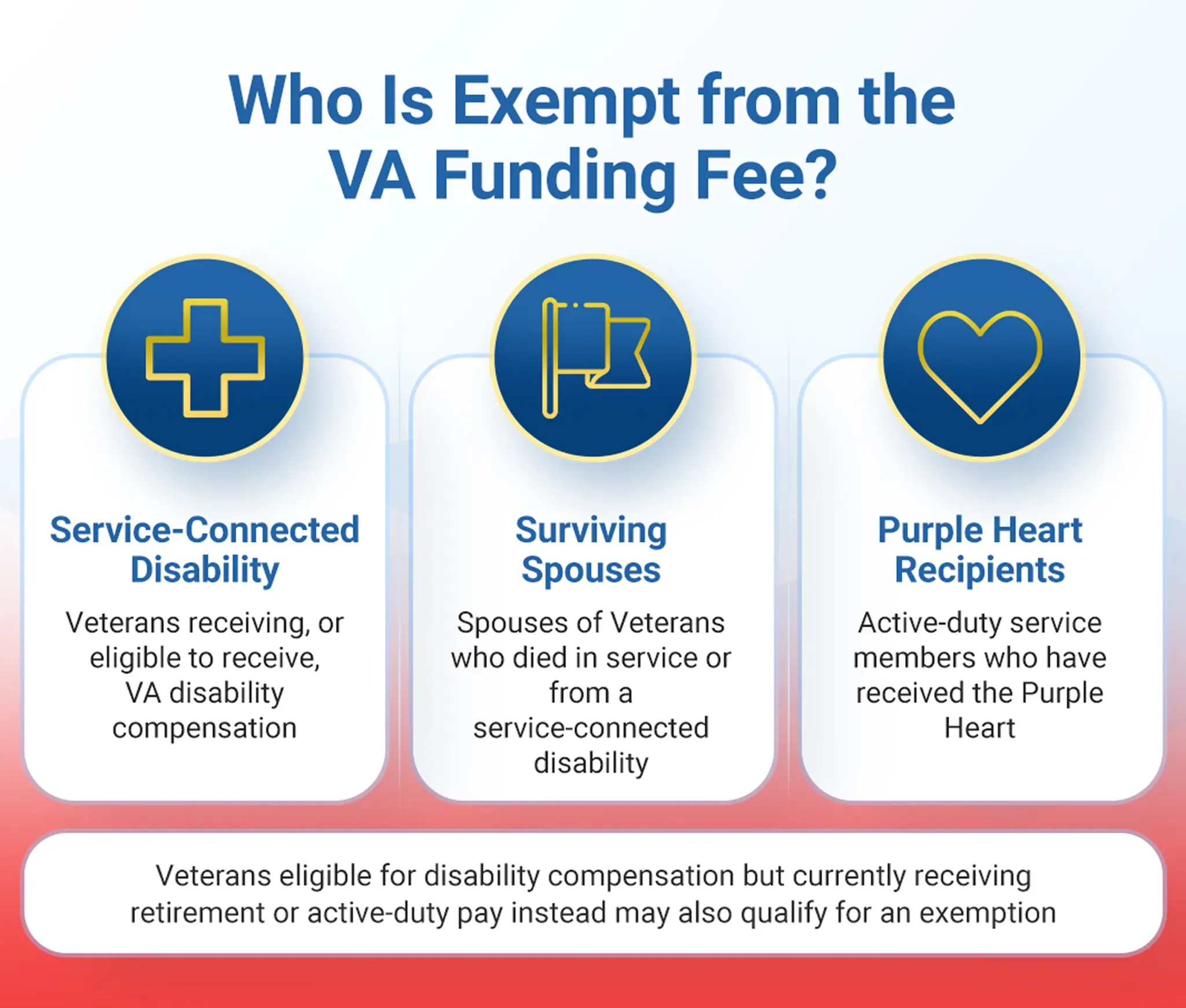
The fee can roll into the loan. Veterans receiving VA compensation for a service-connected disability, Veterans who would receive that compensation but draw retirement or active-duty pay instead, eligible surviving spouses, and Purple Heart recipients on active duty pay no funding fee. If you paid a fee and an exemption applied to you, you may be entitled to a refund.
Which One Fits
The IRRRL fits a Veteran who already has a VA loan, wants only a lower rate or a fixed rate, and can find a lender that offers it. The cash-out fits everyone else: a Veteran with a conventional or FHA loan, a Veteran who wants to reach equity for debt, repairs, or another purpose, or a Veteran whose lender no longer offers the streamline. Whichever you choose, the comparison document, the seasoning dates, and the recoupment math are the same tools, and any lender should be able to walk you through them before you commit.
For more on how each refinance works and what to ask a lender, explore the Learning Center.
FAQs
Can I refinance a conventional loan into a VA loan?
Yes, through a VA cash-out refinance, even if you take no cash out. The IRRRL is only available to borrowers who already have a VA loan on the property.
How much equity can I take out with a VA cash-out refinance?
The VA allows up to 100% of appraised value. Lenders set their own limit within that ceiling, so ask each one for its maximum loan-to-value.
Do I need an appraisal for a VA refinance?
For a cash-out refinance, yes. For an IRRRL, the VA does not require one, though individual lenders may.
How soon after buying can I refinance a VA loan?
Not until the later of 210 days after your first monthly payment and the date you make your sixth payment, for any refinance of an existing VA loan.
What is the funding fee on a VA cash-out refinance?
2.15% of the loan amount for first use and 3.3% for subsequent use, unless you are exempt because of VA disability compensation, surviving spouse status, or a Purple Heart. The fee can roll into the loan.