



Veterans who use a VA home loan are not required to pay private mortgage insurance (PMI). Here's what that means for your monthly payment and how the VA loan benefit works.
What Is Private Mortgage Insurance, and Why Does It Exist?
Before getting into why Veterans are exempt, it helps to understand what PMI is in the first place.
Private mortgage insurance is a type of coverage you're required to buy if you take out a conventional loan with a down payment of less than 20 percent of the purchase price. It protects the lender, not you, if you stop making payments on your loan. In other words, it's insurance that costs the buyer money but delivers zero direct benefit to the buyer. If you fall behind on your mortgage, PMI does nothing to protect you from foreclosure.
VA Loans Don't Require PMI
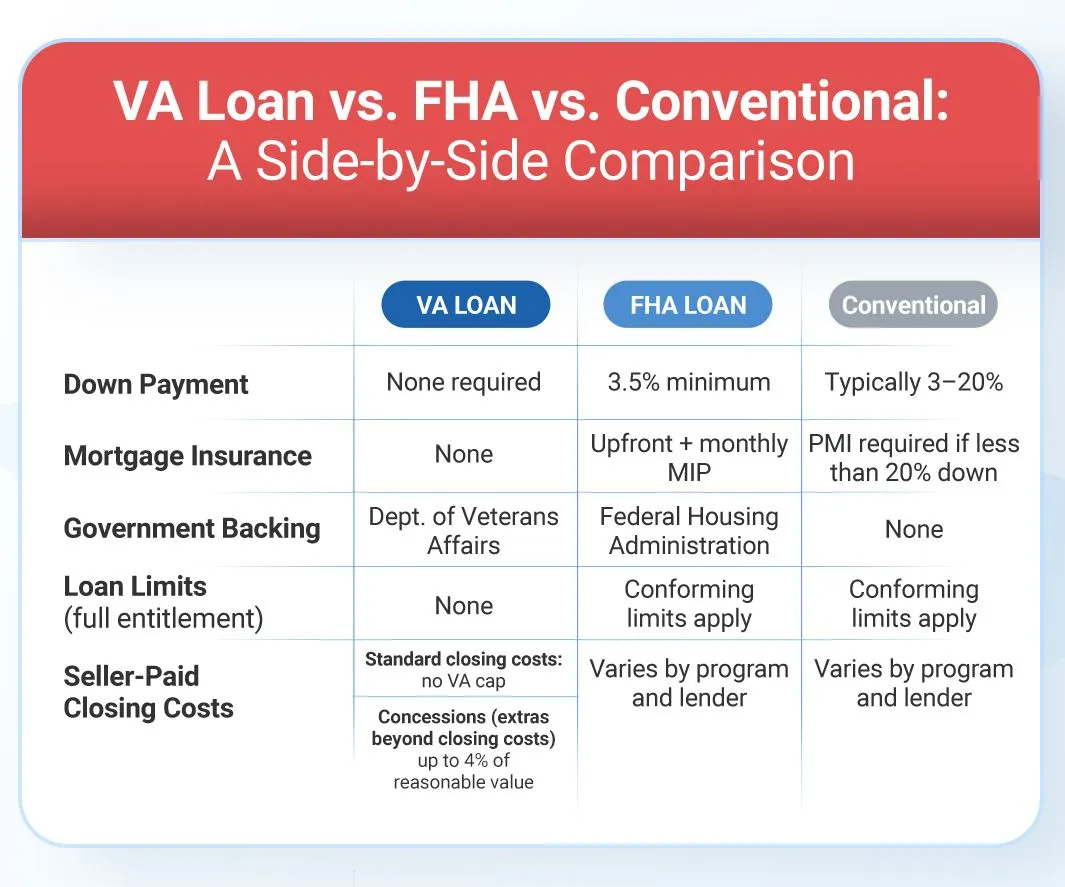
VA home loans have no need for private mortgage insurance (PMI) or mortgage insurance premiums (MIP). PMI is usually required on conventional loans if you make a down payment of less than 20% of the total mortgage amount. MIP is what the Federal Housing Administration (FHA) requires you to pay to self-insure an FHA loan against future loss.
This applies regardless of how much, or how little, a Veteran puts down. A Veteran buying a home with zero down on a VA loan still pays no PMI. That's not a loophole or a temporary waiver. It's a permanent feature of the program by design.
Why the VA Loan Is Structured This Way
The reason VA loans don't need PMI comes down to the government guarantee. VA home loans are provided by private lenders, such as banks and mortgage companies. VA guarantees a portion of the loan, enabling the lender to provide you with more favorable terms.
A VA loan guaranty protects your lender from losing money if you default on your loan. In most cases, this guaranty allows you to buy a home with no down payment.
Because the U.S. Department of Veterans Affairs backs a portion of each loan, lenders already have a safety net. PMI exists to create that same safety net on conventional loans, but with a VA loan, the federal guaranty fills that role. There's no need to layer on a separate private insurance product.
The Real Savings: What No PMI Means Over Time
The monthly savings from skipping PMI are concrete and cumulative. Here's a practical example.
Suppose a Veteran purchases a $400,000 home with no down payment using a VA loan. On a comparable conventional loan at the same price with a 5% down payment, PMI might run 0.6% to 1% of the loan balance annually. On a $380,000 loan balance, that's roughly $190 to $315 per month, which is money that goes straight to an insurance company and builds no equity.
Over five years, that's anywhere from $11,400 to $18,900 out of pocket. Over ten years, the number would double. Veterans using VA loans avoid that cost entirely, from the very first payment to the last.
One Cost That Does Apply: The VA Funding Fee
No PMI doesn't mean no costs at all. Veterans using a VA loan typically pay the VA Funding Fee, which is a one-time charge. It's important to understand how this differs from PMI.
The VA funding fee is a one-time payment that the Veteran, service member, or survivor pays on a VA-backed or VA direct home loan. This fee helps to lower the cost of the loan for U.S. taxpayers since the VA home loan program doesn't require down payments or monthly mortgage insurance.
Unlike PMI, which recurs every month for years, the funding fee is a single charge. For a first-time VA borrower with no money down, the fee is 2.15% of the loan amount. On a $400,000 purchase, that's $8,600, financed into the loan rather than paid at the table. Making a down payment of 5% or more reduces the fee, and 10% or more reduces it further.
Critically, there is no VA funding fee for eligible service-connected disabled Veterans and eligible surviving spouses.
Who Is Exempt from the Funding Fee
Exemptions apply to:
- Veterans receiving compensation for a service-connected disability
- Veterans eligible for disability compensation but currently receiving retirement or active-duty pay instead
- Surviving spouses of Veterans who died in service or from a service-connected disability
- Active-duty service members who have received a Purple Heart
If your disability rating is pending at the time of closing, you'll likely pay the fee upfront. If your claim is later approved with a retroactive effective date, the VA will refund the fee. That refund isn't automatic, so follow up with your lender or the VA directly.
How VA Loans Compare to Other Loan Types
The no-PMI benefit becomes even sharper when you compare VA loans directly to the alternatives.
Conventional loans: PMI required until 20% equity is reached, typically 0.58% to 1.86% of the loan annually.
FHA loans: Require both an upfront mortgage insurance premium (MIP) of 1.75% of the loan amount and an annual MIP. For loans originating after June 2013, if the initial down payment is less than 10%, MIP must be paid for the life of the loan. The only way out is to refinance.
VA loans: No monthly mortgage insurance of any kind. One-time funding fee that can be financed, reduced with a down payment, or waived entirely for eligible Veterans.
That comparison matters most for Veterans who can't or don't want to put down 20%. A VA loan delivers zero-down financing without the ongoing insurance penalty that makes other low-down-payment options expensive over time.